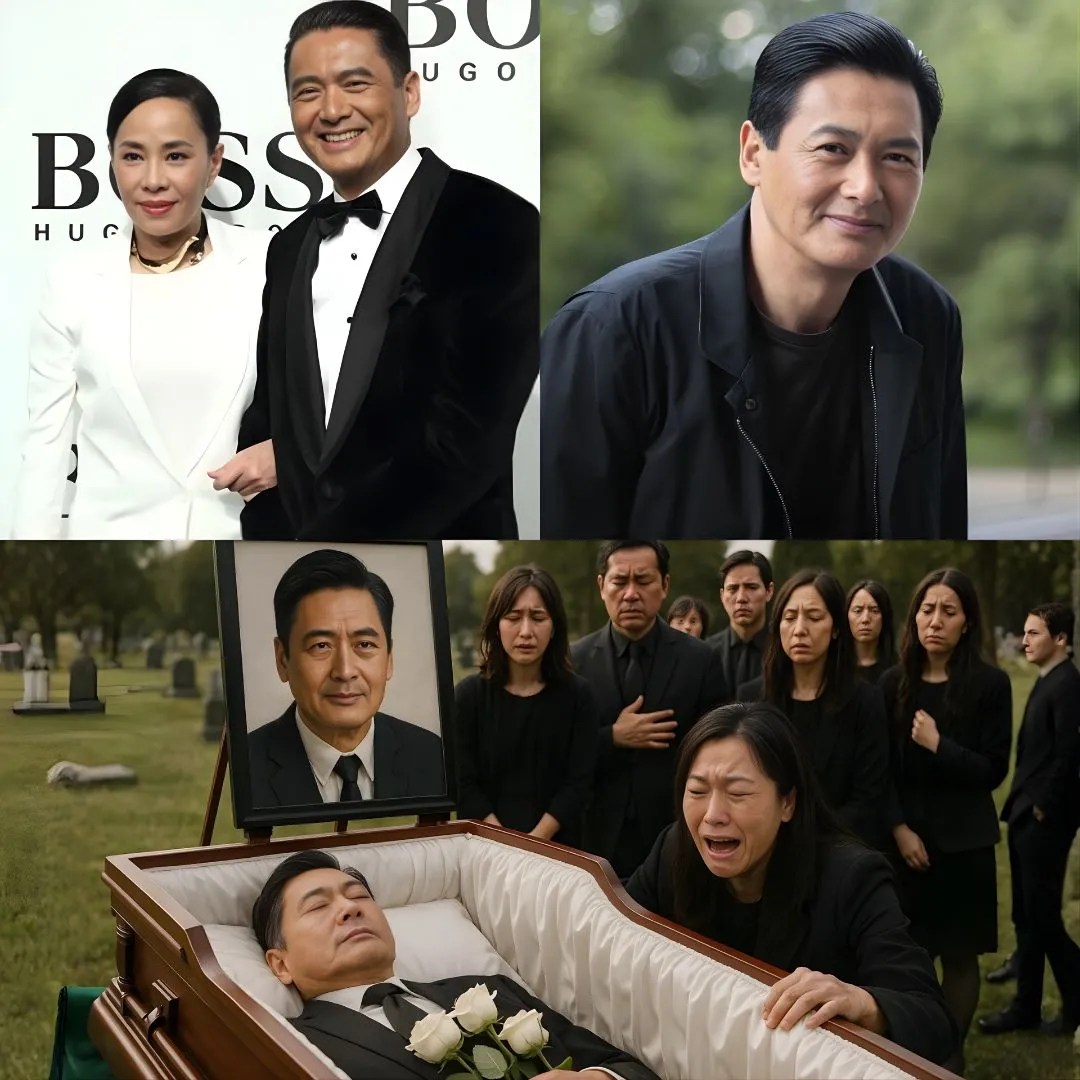
Thirty minutes ago, something unusual happened across the global internet. Timelines slowed. Group chats froze mid-sentence.
The constant churn of commentary, jokes, and headlines briefly lost momentum—as if millions of people collectively inhaled at the same time. And then, just as quickly, everything ignited again, exploding into a storm of shock, heartbreak, admiration, and awe.
The spark?
A confession from the one person who knows Chow Yun Fat more intimately than any fan, co-star, or journalist ever could: his wife, Jasmine Tan.
It wasn’t a press statement. It wasn’t a publicity move. It wasn’t polished, cinematic, or crafted with the elegance one might expect from the wife of an international film legend.
Instead, it was something far more powerful in a world saturated with performance: it was honest. Unvarnished. Human.
And within minutes of her words going live, the world saw the man behind the icon—perhaps for the very first time.
A Truth That Slipped Past the Spotlight
For decades, Chow Yun Fat has occupied a unique space in Asian cinema. He is revered yet humble, legendary yet approachable, and unmistakably timeless. Photos of him riding public buses or handing out free autographs without security often circulate online, each reinforcing the myth of the “untouchable nice guy,” the rare celebrity who emerged from fame with his soul intact.
But myths, even beautiful ones, are only fragments of truth.
In her confession, Jasmine did something almost no one expected:
she gently dismantled the image of effortless serenity that has come to define her husband.
“He isn’t as calm as people think,” she wrote. “At least, not always. And he hasn’t lived untouched by the world. There are nights when the weight he carries would crush anyone else, but he chooses silence so no one feels it but him.”
Fans who have followed Chow for years blinked in disbelief.
The man who exuded command in Crouching Tiger, Hidden Dragon and soulful restraint in A Better Tomorrow was suddenly reframed not as an unshakable figure, but as a deeply feeling human being—one who struggles, bends, and rebuilds himself quietly, far from the cameras.
And Jasmine didn’t stop there.
A Private Chapter They Guarded for Years
If her opening lines cracked the façade, the next part broke it wide open.
“For years,” she continued, “we lived through something no one knew about. We decided together to keep it private, because the world already took so much of him. What we were facing—what we were losing—belonged to just us.”
The admission sent social platforms into a frenzy. What private struggle? What loss? Commentators speculated tensely: illness? family tragedy? a near-divorce they’d hidden from the public?
Jasmine didn’t name the hardship, but she did describe it—and the description was enough to still the screens of even the most casual onlooker.
“It cost us sleep. It cost us time. It cost us pieces of who we thought we were. Some days, the house felt like two strangers trying to pretend everything was fine. Other days, it felt like the world was teaching us how to hold on to each other again.
But we survived quietly. We healed privately. And in that silence, I saw who my husband really is.”
Those words alone reshaped the narrative of Chow’s life—not as a smooth, uninterrupted journey of grace and gratitude, but as one marked by struggle, perseverance, and intimacy only the closest partners share.

Suddenly, the humble movie star riding the subway wasn’t just being down-to-earth. He was carrying something, building something, recovering from something. And millions of fans realized they had never truly known him at all.
What Their Life Has Really Cost
The internet rarely pauses for anything. But thousands of comments testified that Jasmine’s confession struck a universal nerve.
One longtime fan wrote, “I always thought Chow Yun Fat was a man untouched by time, loss, or pressure. Today I realized he’s remarkable not because he’s invulnerable, but because he carries his vulnerability with dignity.”
Another posted, “We admire the legend, but we forget he’s a husband, a friend, a person with private battles. Her words made me respect him even more.”
The quiet cost she described resonated deeply—not because she revealed the details of their suffering, but because she didn’t. The restraint made it real. Everyone has a chapter they don’t talk about: the months spent repairing a relationship, the years spent enduring an illness, the long silence of grief.
By simply acknowledging that such a chapter existed, Jasmine pulled Chow’s image back down to earth and placed him gently among the rest of us.
But while she spoke of cost, she also spoke of something given back.
And What Their Life Has Quietly Given Back
“Whatever we lost,” she wrote, “life returned to us in another form. Not fame. Not fortune. But something quieter: understanding. Patience. A way of seeing each other again after the world tried to blur us.”
She described mornings where Chow would wake early simply to make sure she ate breakfast before her day became hectic. Evenings when he walked beside her, listening without interrupting. Small rituals that, in her words, “stitched our life back together, thread by thread.”
There was a tenderness to her confession that made readers feel like they had stumbled into someone else’s living room—into the soft, unremarkable, precious rhythms of a marriage that had endured something heavy and chosen love again anyway.
And somewhere between the lines, fans found something they hadn’t expected: inspiration.
The comments shifted from shock to admiration. People began posting tributes, recalling moments when Chow’s humility touched them—photos of him sharing umbrellas with strangers, signing autographs for hours without complaint, or donating nearly all his wealth to charity.
Suddenly, these gestures were no longer seen as quirks of a generous celebrity. They were reframed as reflections of a man who had lived through hardship, grown from it, and learned to give more than he received.
A Final Line That Stopped Everyone Cold
Just as the initial storm of reactions began to settle, as readers finished processing the confession and the online world began exhaling again, one final line sparked a second wave of chaos:
“There is more,” she wrote. “But I am not ready to say it yet.”
With that, the internet erupted again—not in outrage or speculation, but in a strange mixture of anticipation and concern. What more could she mean? What story remains untold? Why choose this moment, this platform, this tone, to say what she did?
Journalists scrambled. Fans refreshed her page repeatedly. Discussion threads multiplied with theories and heartfelt pleas for her well-being.
For now, though, silence is all she has offered.
And yet, somehow, the confession feels complete. Not because it answered every question—far from it—but because it gave something rare in a world obsessed with absolute transparency: a glimpse instead of a spotlight.
A truth instead of a spectacle. A moment of vulnerability that needed no further explanation.
What Happens Next
Whether Jasmine ever reveals the rest of her story remains unknown. Perhaps she will choose privacy forever. Perhaps she will speak again when she feels safe to do so.
But one thing is clear: her brief confession has already reshaped the public’s understanding of a man who has long seemed larger than life.
She reminded the world that every icon is also a person, every legend is also a partner, and every quiet marriage carries entire universes that outsiders never see. And in doing so, she inadvertently wrote a love letter—raw, complicated, imperfect, and deeply real—to the man beside her.
Thirty minutes ago, the internet went quiet.
Now, it won’t stop talking.
And somewhere in Hong Kong, two people who have lived through storms the world never saw are probably sitting together in the calm after the noise—just as they always have.