An Ex-SEAL Sniper Bought a Remote Mountain — Poachers Crossed Her Fence and Vanished Overnight
Christmas Eve closes in on the mountain like a lid snapping shut. Wind drives the snow sideways, hissing through the pines. Fresh boot prints cut a clean line toward a newly built fence, eight feet high and crowned with barbed wire, the kind of boundary meant to make people turn around.
Whoever left those prints did not slow down. They moved without caution, laughing low, convinced the land beyond the fence belonged to no one who mattered. In places like this, they believed, isolation meant weakness.
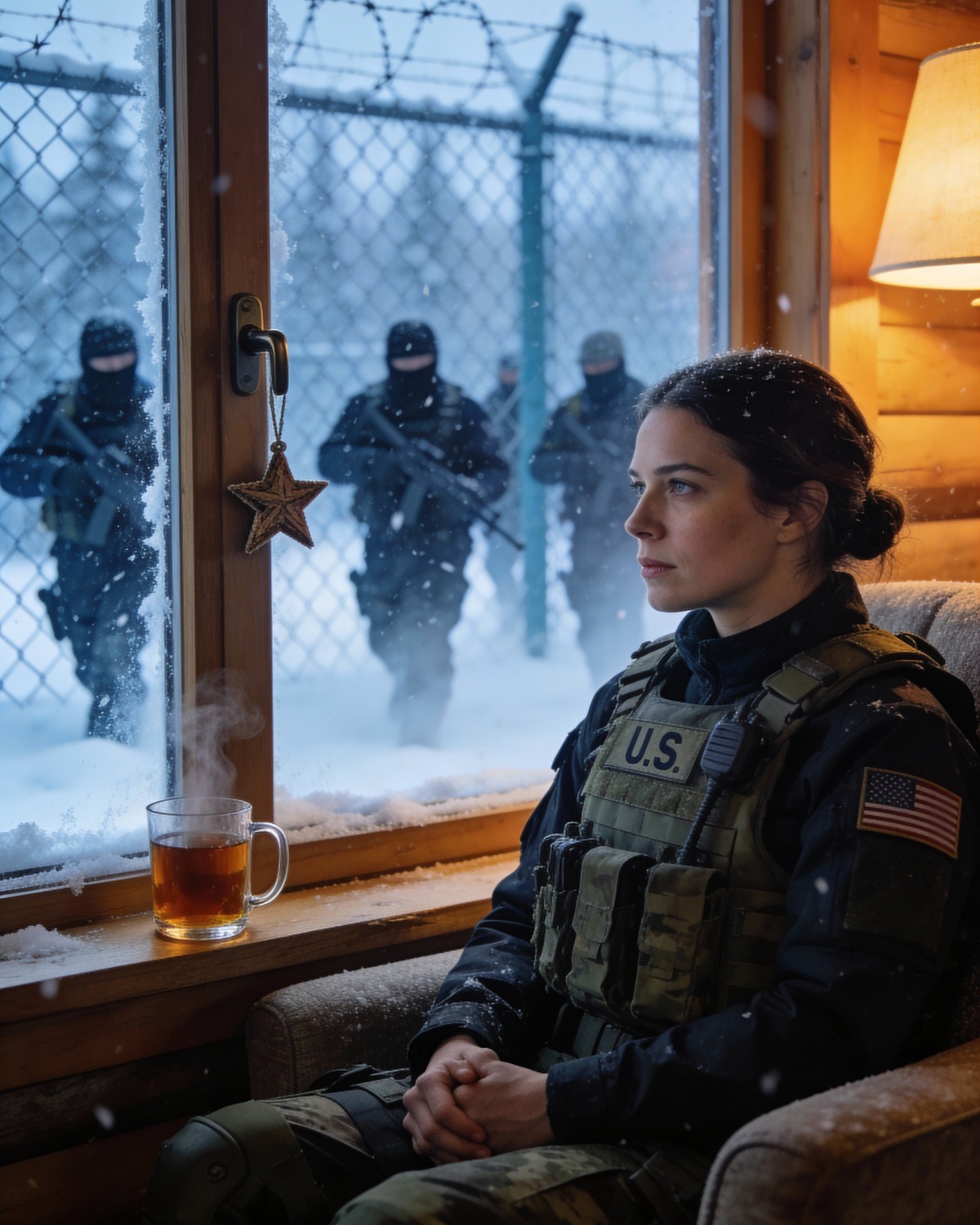
Inside the cabin, Captain Evelyn Cross does not react like a frightened civilian. She does not rush for a phone or peer through the glass. She studies a monitor and exhales once, slow and measured, recognizing a problem she has faced before under very different skies.

The disrespect is quiet but complete. Men assuming the property is empty, assuming the woman inside is alone in the way civilians mean it, assuming no one is watching them cross a line that should not be crossed.
A small wooden star hangs in the window, catching the last amber light of the day. It looks fragile against the dark timber and gathering storm. It is not.
Captain Evelyn Cross was in her mid-thirties, but the stillness in her face made her seem older, like someone who had already spent her share of years listening for danger. She lived alone now, legally retired, a civilian on paper and a ghost in habit.
Once, she had been a United States Navy SEAL sniper. In that world, she carried the callsign Echo-3, not as a nickname but as a role that came with weight. The kind of weight that does not leave your shoulders just because you turn in a uniform.
She bought the mountain in early autumn, eight hundred acres of hard silence, and she paid for it in full. She asked the realtor for one thing that was more valuable than a view: keep it quiet. No announcements, no friendly welcome baskets, no curious strangers making their way up a road that barely deserved the name.
The town noticed anyway. Small places always do. A woman arrives alone, buys land no one wants, and keeps her head down, and people start building stories to fill the empty space.
Some said she was a rich recluse, hiding money and secrets where nobody could find them. Others decided she was a survivalist, the kind that feared the world so much she needed to live above it. A few whispered that she was running from something, and the way they said it made it sound like she should be ashamed.
Evelyn never corrected them. She wore plain clothes, faded layers, boots chosen for terrain instead of appearance, and nothing about her asked for attention. There were no medals, no unit hats, no stickers on her truck, and no stories in her mouth.
Her calm made people uneasy because they could not place it. Most people in town smiled too fast, laughed too loud, or tried too hard to seem harmless. Evelyn’s eyes did none of that.
They did not seek approval, and they did not apologize for existing. When she walked into the feed store or the hardware aisle, she moved like someone used to being assessed, not paranoid. Just aware.
She gave short nods, paid in cash when the card reader glitched, and left before anyone could trap her in conversation. Up on the mountain, she built a life that looked strange to anyone who had never lived under orders. The cabin was simple, but every choice inside it was deliberate.
Tools lined up, not for neatness, but for speed, because a hand should never have to search in the dark. She reinforced the cabin alone, roof patched before weather could test it, insulation tightened, a wood stove installed like it was a mission requirement. She carried lumber in quiet trips, never rushing, never complaining, and never inviting anyone to feel sorry for her.
She watched the wind the way other people watched sunsets. Not for beauty, but for information. She learned how it fell through the valley in the morning, how it lifted near the granite ridge, how it changed its mind at dusk without warning.
The perimeter came next: a fence, high and new, with barbed wire that made the boundary clear even under heavy snow. Trail cameras, motion sensors, angles of approach mapped in her head, and clear lines she never explained to anyone. To the townspeople, it looked excessive, like fear dressed up as construction.
To Evelyn, it was the minimum. It was not obsession. It was control after chaos, the kind that allowed a person to breathe without waiting for a knock that should not come.
There were nights she sat in a chair facing the window, not in a dramatic way, but in the simple posture of someone who did not fully trust sleep. She would watch the dark settle, listen to the pines, and let the quiet remind her that nothing was happening. Sometimes, in those moments, she would glance at the small wooden star hanging in the window.
Hand-carved, imperfect, and plain, she had put it there because she wanted something in her life that did not come from training. The only local who did not treat her like a rumor was Eleanor Briggs. Eleanor was older, strong in the way mountain women become strong, with hands marked by work and eyes that could read a person without needing permission.
Eleanor ran errands that kept her moving between town and the edges of the National Forest. She knew which trucks belonged, which ones were new, and which ones never stopped at the diner but still ended up on the back roads. She met Evelyn the way you meet someone you decide is worth knowing.
No flattery, no nosy questions, no fake warmth. Just a casserole left on the porch one evening with a note that said, «You will need this when the weather turns mean.»
Evelyn did not invite her in that first time. She did not know how. But she stood on the porch in the cold, holding the warm dish like it was something fragile, and for a moment her face softened into something almost human.
Eleanor never asked about the fence or the cameras. She asked if the stove drew well and if the roof would hold. She asked what kind of coffee Evelyn drank, and when Evelyn answered, Eleanor nodded like she had just gathered useful information for later.
It was Eleanor’s gift, that restraint. She sensed the weight on Evelyn’s shoulders and did not poke at it. She treated Evelyn like a person, not a mystery, and that alone made her different than everyone else in town.
The past still followed Evelyn, even when she did not speak it out loud. It came in small flashes, a sound in the wind that reminded her of rotor wash, a certain kind of darkness that looked too much like another winter far away. Seven years earlier, on another cold season, she had lay in a hide with her spotter, Petty Officer First Class Luke Harlan.
He was young, sharp and steady, the kind of operator who could read wind like a language and still make you laugh on the worst nights. Luke had been beside her when things went wrong, a mission built on bad intelligence, a mountain range that swallowed sound, a target that was not where they said he would be.
Evelyn still remembered the moment the night changed shape, how the calm turned into something jagged. Luke did not come home from that operation. There was no heroic speech, no clean closure, no satisfying reason that made it acceptable.
There was only absence, and Evelyn carrying the memory of how quickly a life could disappear when someone else’s decision failed you. Their troop commander, Commander Marcus Hale, survived the fallout. Careers have a way of doing that.
He took the reprimand, he wore the consequences with practiced professionalism, and the machine kept moving. Evelyn did not hate him. Hate was too easy and too loud.
What she carried was something colder, a loss of trust that settled in her bones like winter. The Navy had offered her options afterward: desk jobs, training roles, a future that looked safe on paper. They had called it taking care of their own.
Evelyn knew what it really was: a quiet way of moving her off the board because the system did not know what to do with someone who had seen its failures up close. She left without ceremony. No bitterness, no dramatic exit, no public complaint.
She just stepped out of that world and tried to build a new one where the rules were not written by people far away. The mountain represented something simple that felt almost impossible: no surprises. No strangers walking into her life with a smile and a hidden intention.
No one else controlling the timeline of disaster. Up here, Evelyn made the rules. Up here, she could see the approaches, feel the wind, read the land, and decide what crossed into her life and what did not.
That was what the town never understood when they called her paranoid. It was not fear that built her perimeter. It was experience.
And in the quiet between the pines, with the cabin warm and the fence buried under new snow, Evelyn Cross tried to believe that experience could finally serve peace instead of war.
The first alert arrived late on Christmas Eve when the world outside her cabin had turned into a moving wall of snow and wind. Evelyn was rinsing a mug at the sink when her phone vibrated against the counter, the quiet buzz loud in a room that had been silent for hours. Southeast perimeter.
She dried her hands once, slowly, then picked up the phone and opened the live feed like she had done a hundred times since moving in. Usually it was deer, occasionally a fox, once a black bear that had paused near the fence like it was thinking. This time it was men.
Five figures, moving through the trees with deliberate spacing, not clustered like hikers and not sloppy like weekend hunters. Their pace was steady. Their heads stayed up, their hands signaled without noise.
One carried a long case that did not belong to a fishing rod. Another wore a pack too structured to be for camping. They approached the fence without hesitation, as if the fence itself was only an invitation to measure her.
Evelyn zoomed in. Even through the grain of night vision and blowing snow, she saw enough. Weapons. Optics. Gloves that kept fingers warm but allowed precision.
One of them paused, tilted his head, and studied the camera’s position like he knew what he was looking for. This was not hunting. This was testing.
Her first instinct was the one she had spent years training into her bones: Identify. Predict. Control.
Her second instinct, the one civilians had, arrived a heartbeat later. Call someone. Make it official. Hand the problem to a system that existed for exactly this reason.
She stared at the phone, thumb hovering over the emergency number, and already knew the result. A dispatcher who would ask for an address that barely existed. A deputy who would arrive hours later, if at all, driving slow through mountain roads and wondering why a woman with a fence and cameras was calling on Christmas Eve.