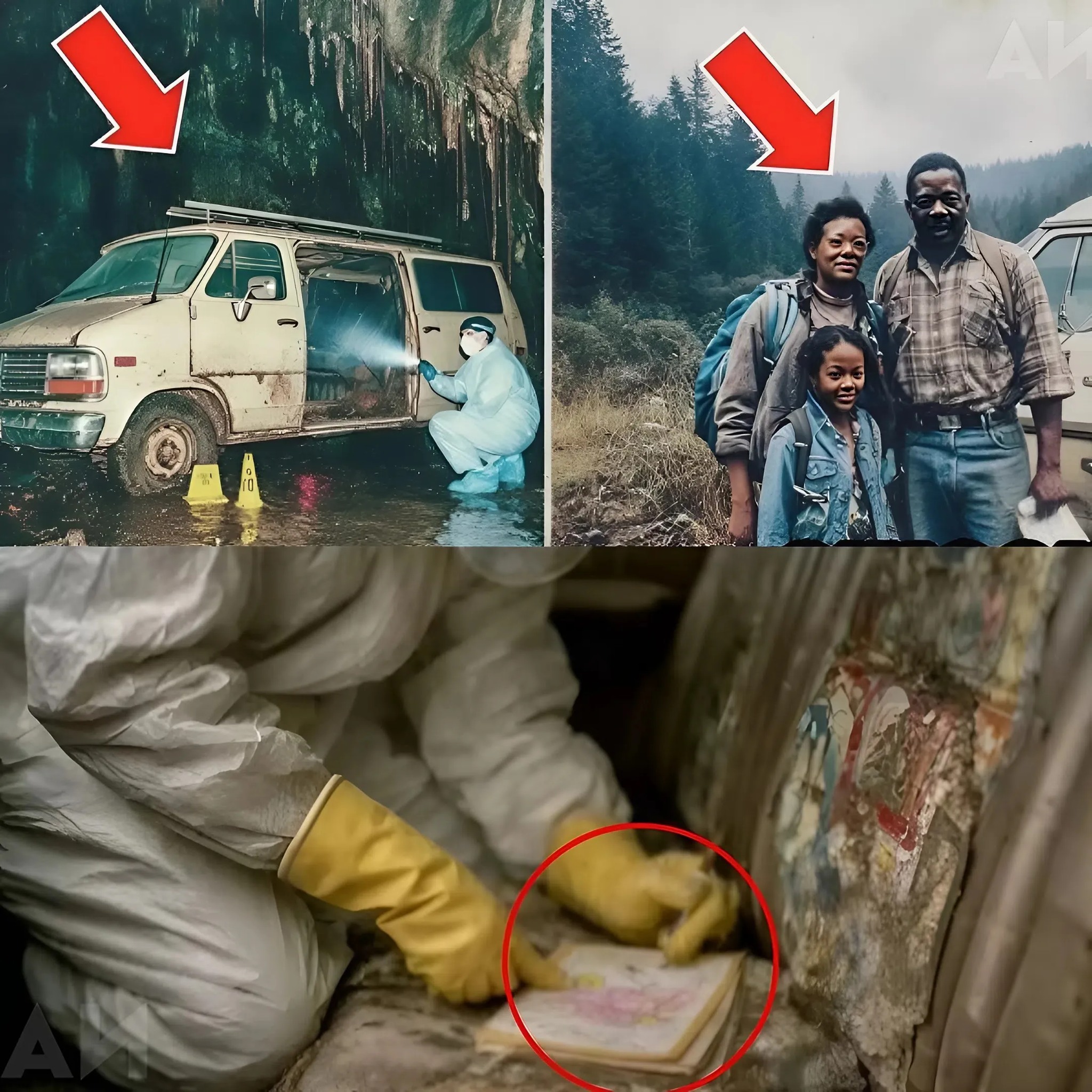
For ten long years, the disappearance of Mark Ellison and David Kerr was one of those haunting but unsolved tragedies that small towns eventually fold into their folklore.
The two friends had vanished during a weekend road trip in the summer of 1985, last seen filling their gas tank at a station on the edge of Pine Hollow National Reserve. Their families had waited. Volunteers had searched.
The police had followed every lead that flickered briefly before fading into cold nothing. By 1987, the case file had been thinned down to its bones. By 1991, it gathered dust in a drawer.
Locals learned to live with it. Some theorized the two young men had run off to escape debts or draft notices. Others assumed their van had tumbled into a ravine or that they’d met with foul play far from home.
But most simply accepted that Pine Hollow kept its secrets, and this one, carved into the memory of two grieving families, was destined to remain unsolved.
Everything changed on September 14, 1995.

The Discovery Nobody Expected
It was early afternoon when veteran spelunker Riley March radioed park authorities from deep inside the sprawling limestone cave system informally known as The Driftworks.
March had been mapping undocumented branches when his headlamp washed over something that didn’t belong—a dull metallic edge protruding from a natural stone chute, barely visible beneath sheets of dust and root tendrils.
At first glance, he thought it was debris dragged in by floods. Then he noticed the curve of a windshield buried under sediment. A tire, collapsed and green with moss. A rust-eaten bumper.
It was a vehicle—a van—suspended awkwardly in a narrow cavity no broader than the chassis itself, as if the earth had swallowed it whole.
When March wiped his glove across the cracked window and saw shapes inside, he stopped breathing long enough to radio for help.
Within three hours, investigators from the county sheriff’s office, the state park service, and later the FBI descended into the cave system with equipment, floodlights, and a guarded sense of dread.
No one expected what they would find.
A Time Capsule of the Lost
Even before the doors were pried open, it was clear the van had been preserved in conditions that felt almost deliberate. There was no water damage inside. No animal intrusion.
Every object appeared frozen in the moment the doors had last shut—cigarette packs, torn road maps, a duffel bag, a portable cassette player, and a camera containing undeveloped film.
The bodies were not inside.
But what chilled investigators most was the message.
Scratched into the interior metal paneling with frantic, uneven strokes, the words formed a plea or a warning—no one could decide which.
“DON’T FOLLOW THE LIGHT.”
Below it, carved so deeply the metal curled outward, were three ragged letters: RUN.
The air inside the vehicle was stale, heavy with the scent of earth and age. But there was no mistaking the desperation behind the gouged message. Something had terrified whoever wrote it.
And it had terrified them enough to try cutting their words into steel.
The van was confirmed the next morning as belonging to Ellison and Kerr. Their families, after years of silence, were given the first sliver of closure. But the discovery only ushered in a far darker set of questions.
Footprints That Shouldn’t Exist
A sweep of the surrounding chamber suggested the van had plummeted through a collapsed sinkhole sometime in late 1985. But the cave tunnel into which it had fallen was remote—far from any marked roads or trails.

It would have been impossible for the two young men to have driven to such a location deliberately. Experts determined the ground above must have given way beneath them, swallowing the vehicle and sending it crashing through layers of limestone.
But where were the bodies?
That answer seemed poised to reveal itself when one of the investigators—hiking farther down the passage—noticed a line of dust-coated impressions leading deeper into the earth. At first, they appeared old, barely more than preserved indentations.
Then the forensic team illuminated them with high-intensity lights.
The tread was sharp. Edges crisp. Heel-to-toe sequencing consistent with recent travel.
The footprints were fresh.
And they did not match the boots worn by any member of the search team.
Even more unsettling, their spacing suggested someone moving quickly—not stumbling or crawling as one might expect after surviving a vehicle plunge into a cavern, but running. Running with purpose. Running from something.
The prints vanished abruptly near a forked passage where the cave floor transitioned from dust to slick calcite. Past that point, no trail remained.
The Unanswerable Questions
The emergence of fresh footprints reignited public speculation and launched an investigation that expanded far beyond the disappearance itself. How could prints appear a decade after the supposed collapse?
Had someone else stumbled across the van before March? Was one of the missing men still alive—impossibly, unbelievably—after ten years?
The FBI remained cautious, releasing only what was necessary. But leaked internal memos suggested agents were deeply troubled by the possibility that the footprints did not belong to Ellison or Kerr at all.
Several details supported this fear:
-
The bootprint size didn’t match either man’s shoe size listed in the original missing persons report.
-
The stride length was slightly irregular, as if the individual favored one leg—or carried significant weight.
-
There were faint drag marks beside some prints, like fingertips brushing through dust, or something being hauled.
Local geologists also claimed the cave chamber where the footprints were found had no known entrances large enough for a person to slip through without specialized gear.
There was no sign of recent spelunking activity, no dropped ropes or chalk marks, nothing to suggest a hiker or explorer had wandered in.
Something—or someone—had been down there.
And the message carved into the van’s wall felt suddenly less metaphorical and more literal.
Unreleased Film and a Growing Fear
When technicians developed the camera film recovered from the van, several images emerged: blurry shots of roadside scenery, an out-of-focus self-portrait, an empty stretch of highway.
The final photo was taken inside the cave—grainy, dark, and smeared with motion blur. Investigators worked to enhance it, but the result only deepened the mystery.
The image showed the dashboard illuminated faintly by the van’s interior light. Dust floated in the air. And in the right corner—half obscured by shadow—was a shape. Tall. Upright. Featureless.
Some believed it was a trick of the cave wall. Others insisted it looked like a person standing just beyond the passenger-side door.
The FBI declined to comment.

What the Cave Still Holds
Attempts to map the deeper tunnels were halted after two members of a recovery team reported hearing rhythmic tapping sounds echoing through the stone. Others described the sensation of air movement from impossible directions.
One climber returned to the surface shaken, unable to explain why his helmet light flickered only in specific sections of the cave.
He requested reassignment the next morning.
Officials have since restricted access to The Driftworks, citing structural instability. But locals whisper that the real reason lies in what investigators found—or heard—when they followed those footprints into the dark.
As of today, the bodies of Mark Ellison and David Kerr remain unrecovered. The case, once labeled a tragic accident, has been reopened with an entirely different classification.
Not an accident.
Not simply a missing persons investigation.
But a potential crime.
And something else—something investigators refuse to define on the record.
The cave has not been searched fully. The van has not been moved. And the footprints, though photographed extensively, have already begun to fade.
Whatever happened down there in 1985 was terrible.
And according to the men who first stepped into that underground chamber, it wasn’t finished.