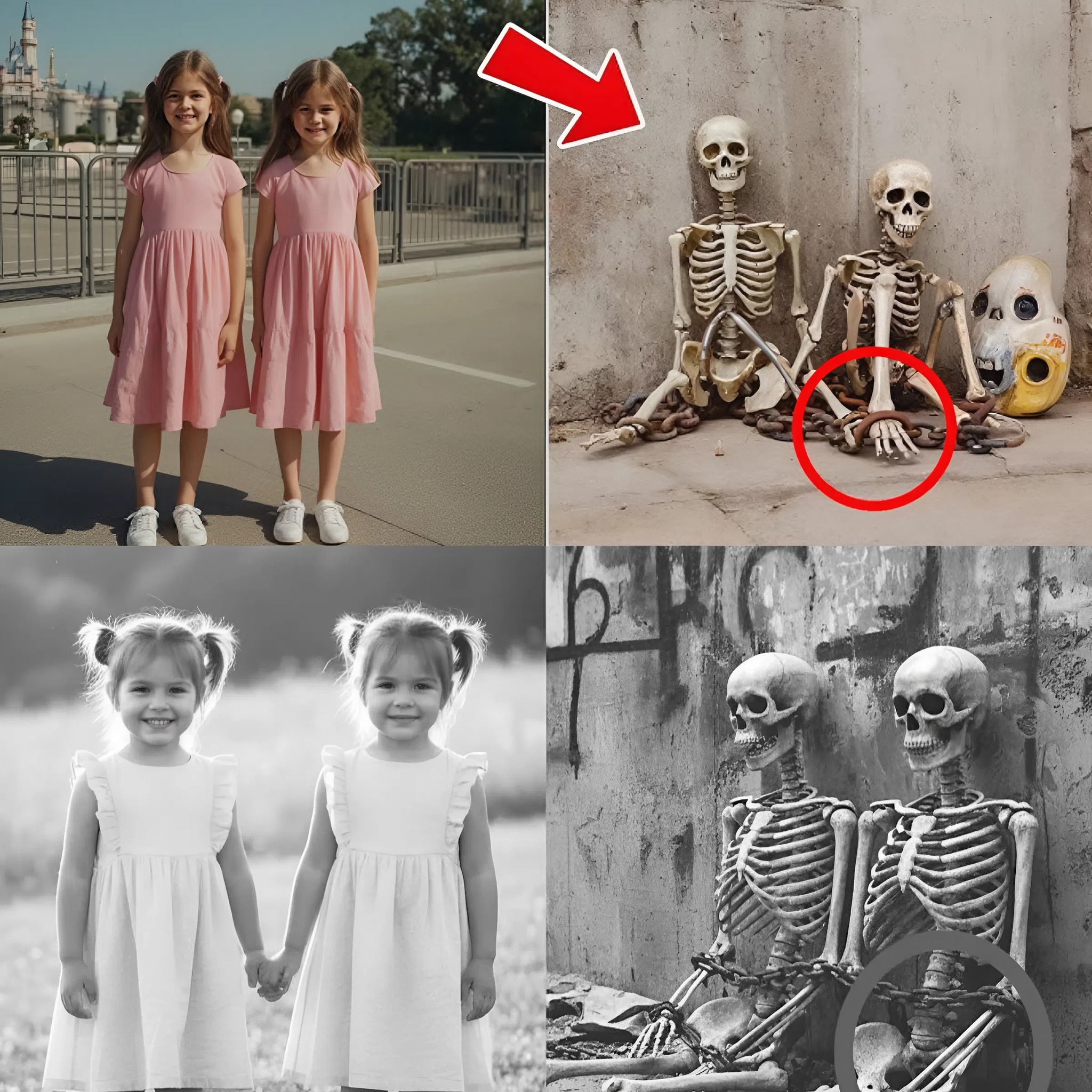
A photo with Mickey Mouse, two smiling girls, and a park full of magic… In minutes, everything turned into a nightmare.
In the summer of 1985, Disneyland was alive with its usual symphony of laughter, music, and the hum of families chasing an idealized slice of joy.
Tourists lined Main Street with cone-shaped hats, clutching their maps and ticket stubs, waiting for the famous parade to begin. Among them was the Li family — a mother, father, and their identical seven-year-old twins, Xiao and Xiaolan.
A photograph taken at 11:02 a.m. shows the last known image of the girls. They stand beside a cheerful Mickey Mouse performer, each gripping one of his gloved hands. Their smiles are bright, excited, unguarded.
Behind them, Sleeping Beauty Castle towers in the background, its pastel walls glowing beneath a cloudless California sky.
By 11:17 a.m., the twins were gone.
What followed was one of the most baffling and haunting disappearance cases ever associated with a theme park — one wrapped in conflicting eyewitness accounts, internal documents that mysteriously vanished, and rumors that grew more elaborate with each passing decade.
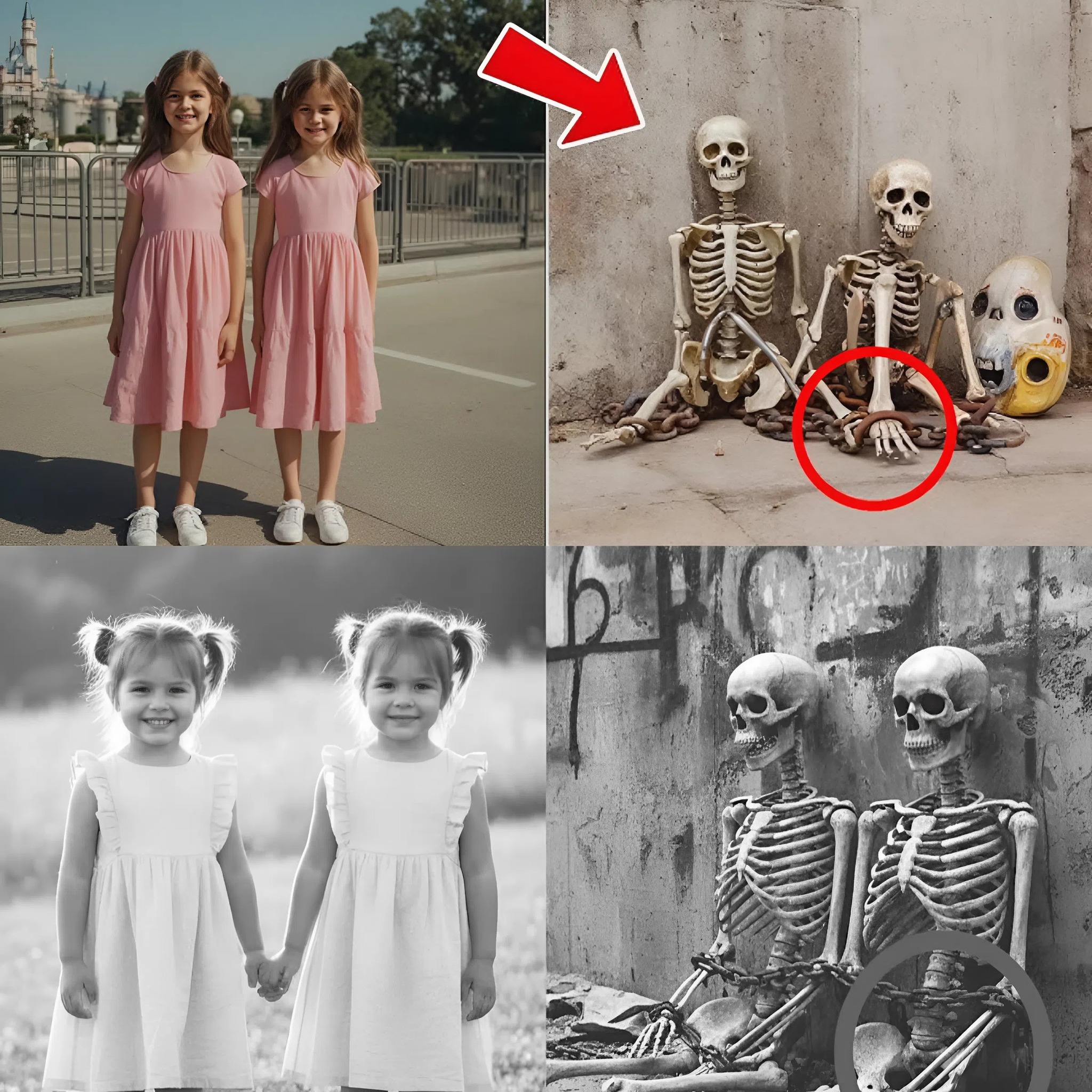
For years, the story faded to a quiet urban legend whispered among late-night security guards. A tragedy no one could explain, and few wanted to remember.
Then, in 2013 — 28 years after the girls vanished — construction workers renovating an old maintenance area beneath the park made a discovery that would reignite the mystery and expose something far more sinister than anyone imagined.
A Day Meant for Magic
The Li family had traveled from San Francisco to Anaheim for a long-awaited vacation. According to the official report filed at the time, the girls were last seen near the entrance to Fantasyland.
Their mother had briefly turned to adjust her backpack; when she turned back, the twins were nowhere in sight.
Witnesses offered contradictory statements. One claimed she saw the girls chasing a balloon toward the carousel.
Another insisted she had noticed a man in a “worn-looking Mickey costume” leading two children by the hand toward a staff-only gate. Security logs later stated that all Mickey performers were accounted for and in the correct locations that day.
The park shut down several attractions and deployed hundreds of staff in a sweeping search. Police combed through storage rooms, underground access points, and utility corridors.
Trained dogs were brought in but found nothing. No clothing, no belongings, no signs of struggle.
“It was as if they dissolved into the air,” one retired officer recalled years later.
The case made national headlines but quickly collided with a wall of dead ends. There were no ransom notes, no suspects, no evidence. After months of coverage, the story faded.
Disneyland, eager to restore its spotless reputation, released carefully worded statements but avoided acknowledging the more troubling theories circulating among employees.
Rumors in the Tunnels
Every large theme park has an underbelly — a network of maintenance corridors, storage facilities, and break rooms hidden beneath the cheerful facade. Disneyland’s infrastructure is smaller than its Florida counterpart but still extensive enough for rumors to thrive.
Former employees later confessed that for years they heard whispers about a “phantom performer” — a man who wandered backstage in mismatched costume pieces, never speaking.
Some said they saw him only briefly, as if he slipped between the margins of the park. Others believed he was a disgruntled former cast member sneaking in for thrills.

None of these stories were ever confirmed. Officially, no unauthorized person had ever accessed secure costume areas or employee-only tunnels.
Unofficially, staff spoke of areas beneath Fantasyland that were “off-limits,” sections of old maintenance tunnels sealed after renovations in the 1970s. These spaces, they said, were originally used for storage but became “structurally unstable.”
Few questioned it. In a place built on illusion, secrets often disappeared behind painted doors.
The 2013 Discovery
When Disneyland began a renovation project in late 2013, workers were tasked with clearing out an unused corridor beneath the park — a narrow, low-ceilinged passageway blocked by decades of disuse.
No one expected the air to be so cold, or the dust so thick it clung to their clothing like ash.
Forty-two feet into the tunnel, behind a crumbled section of wall, they found bones.
At first, the discovery was quietly labeled “historic remains,” possibly from the early construction era. But forensic examination revealed something chilling: the bones belonged to two children, approximately the age Xiao and Xiaolan would have been in 1985.
The analysis also revealed something else — the remains were positioned deliberately, not scattered. Beside them lay fragments of fabric: faded red cloth, white synthetic stuffing, and what seemed to be pieces of a costume.
Disneyland officials contacted authorities, but the details never made it into public press releases. Workers were told not to speak to media. The area was sealed again, and renovation plans were altered.
But leaks happen. The story reached former employees, then internet forums, then amateur investigators. Soon, journalists began digging.
The “Character” in the Walls
A retired costume department supervisor, speaking anonymously, described a troubling incident from the mid-1980s: a set of mouse-shaped gloves that had gone missing for weeks, only to reappear stained with something brownish.
She had reported it to security, but the matter was quietly dismissed.
Another former cast member recalled spotting a man wearing a mascot head that “wasn’t one of ours.” According to him, the man stood perfectly still in a dark corridor, watching him silently.
When he returned with a supervisor, the figure was gone.
No CCTV footage from that era survives — or so the park claims. But scattered testimonies suggest a pattern: someone who knew the tunnels intimately, someone who understood cast schedules, someone with access to costume parts.
When law enforcement reviewed the original disappearance files alongside the new remains, they re-examined a staff member from 1985 who had abruptly quit days after the twins vanished.
He had worked in renovations, with access to maintenance corridors. Records showed he often volunteered for backstage shifts in Fantasyland.
He died in 1992.
Police concluded the case could not be pursued further.
A Secret Buried Beneath the Magic
Disneyland released a short statement acknowledging that “historic remains” had been discovered during routine refurbishment, insisting that there was no evidence linking the find to park operations.
They did not mention the age of the remains, the costume fragments, or the reopened investigation.
Privately, some employees say the park quietly restructured its backstage systems, installed new locks, and mapped areas long ignored. A few claimed that sealed tunnels had been filled with concrete entirely.
Families visiting the park today walk above those empty spaces, unaware of what once lay beneath their feet. For most, Disneyland remains the happiest place on earth — a place untouched by tragedy.
But for the Li family, the magic stopped in 1985. Their daughters’ case remains officially unsolved, though the discovery in 2013 gave them the smallest, bitterest sense of closure.
They were offered a private meeting with investigators, but details of that conversation have never been made public.
A Legacy of Shadows
Urban legends flourish where facts fail, and this case has become a breeding ground for conspiracy theories. Online communities speculate about hidden labyrinths, unauthorized performers, and “dark magic” lurking behind the scenes.
Some theories are absurd; others too close to plausible.
What is certain, however, is that two children entered the park one summer morning and never came home. And nearly three decades later, their remains surfaced in a place that was supposed to be pure joy.
The happiest place on earth has always depended on one rule: what happens backstage stays backstage.
But sometimes, the past refuses to stay buried.