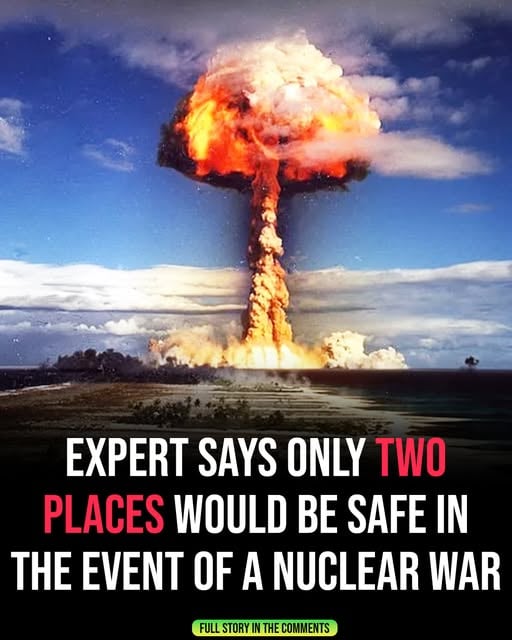
As U.S.–Iran Conflict Escalates, Americans Ask: Where Could You Survive a Global War?
Tensions between the United States and Iran surged over the weekend after U.S. and Israeli airstrikes struck multiple Iranian cities, prompting renewed anxiety over the possibility of a broader war — and even speculation about nuclear conflict. In the United States, many are asking a stark question: if a global war erupted, where in the country might offer the best chance of survival?
From “Duck and Cover” to Real Concerns
During the Cold War, U.S. schools taught students “duck and cover” drills in preparation for a potential Soviet nuclear attack — a symbolic gesture that offered limited real protection. Today’s geopolitical landscape is very different, but the specter of nuclear escalation has reentered the public conversation.
The Biden administration and some U.S. officials have accused Iran of restarting its nuclear program and advancing missile capabilities that could someday reach U.S. territory. Independent reporting has found aspects of those claims remain unverified or disputed, but they have nonetheless been cited to justify recent military strikes.
U.S. Strikes and Iranian Leadership
According to international news outlets, including Sky News, the joint operation — referred to by some analysts as Operation Epic Fury — targeted major Iranian cities such as Tehran, Isfahan, Tabriz, Kermanshah, and Qom. Some reports also claimed that Iran’s Supreme Leader, Ali Khamenei, was killed in the attacks, though independent verification of that claim remains unclear.
U.S. officials have publicly warned Iran against retaliatory strikes, but military analysts caution that counterattacks — particularly on American military or nuclear infrastructure — could rapidly escalate the conflict.
Where America’s Nuclear Arsenal Is Located
The United States maintains a strategic missile force of approximately 2,000 deployed nuclear warheads. The bulk of these are based in the central and northern Plains states — including Montana, North Dakota, Nebraska, Wyoming, and Colorado — where long-range missile silos are clustered. These locations would be primary targets in a U.S.–Russia or U.S.–China nuclear exchange, analysts say.
Experts caution that a direct strike on U.S. missile fields would have devastating local consequences, including high levels of radioactive fallout. Radiation exposure in surrounding states could range widely, with doses well above lethal thresholds in areas close to impact sites.
States Considered Relatively Lower Risk
Some analysts, including coverage by Newsweek, have mapped relative risk zones based on distance from known military and nuclear infrastructure. According to these assessments, states farther from missile silos and major strategic targets — particularly along the East and Southeast coasts — might experience lower immediate radiation risk in a hypothetical nuclear scenario.
States frequently cited as relatively lower risk include:
- Maine, New Hampshire, Vermont
- Massachusetts, Rhode Island, Connecticut
- New York, New Jersey, Pennsylvania
- Delaware, Maryland, Washington D.C.
- Virginia, West Virginia
- North Carolina, South Carolina, Georgia, Florida
- Alabama, Mississippi, Tennessee, Kentucky
- Ohio, Indiana, Michigan
Other regions sometimes mentioned as having comparatively lower fallout exposure include parts of the Pacific Northwest and Southwest, such as Washington, Utah, New Mexico, and Illinois.
However, experts stress that “lower risk” is not the same as “safe,” and modern nuclear conflict would have widespread, unpredictable effects.
Long-Term Survival and Global Impact
Even if Americans could escape the worst of an initial exchange, long-term survival poses additional challenges. Scientific modeling suggests that a large-scale nuclear war — especially targeting silo fields across Colorado, Wyoming, Nebraska, Montana, and North Dakota — would not only devastate local regions but could contaminate fertile agricultural land for years.
On the international stage, analysts and policy commentators have noted that countries in the Southern Hemisphere — such as New Zealand and Australia — might be less affected by nuclear fallout and atmospheric disruption in the event of global nuclear warfare.
Investigative journalist Annie Jacobsen has described how a prolonged “nuclear winter” could drastically reduce sunlight and agricultural viability across much of the Northern Hemisphere, potentially triggering widespread famine and social collapse.
What Experts Emphasize
Despite rising public concern, military and scientific experts warn:
- No region would be completely immune in a full-scale nuclear conflict.
- Fallout, climate effects, and global supply disruptions would have broad, long-lasting consequences.
- Preventing escalation remains far more critical than debating “safe zones.”
As international tensions continue to unfold, policymakers, analysts, and citizens alike are watching closely — aware that modern conflict carries stakes far beyond traditional battlefield lines.