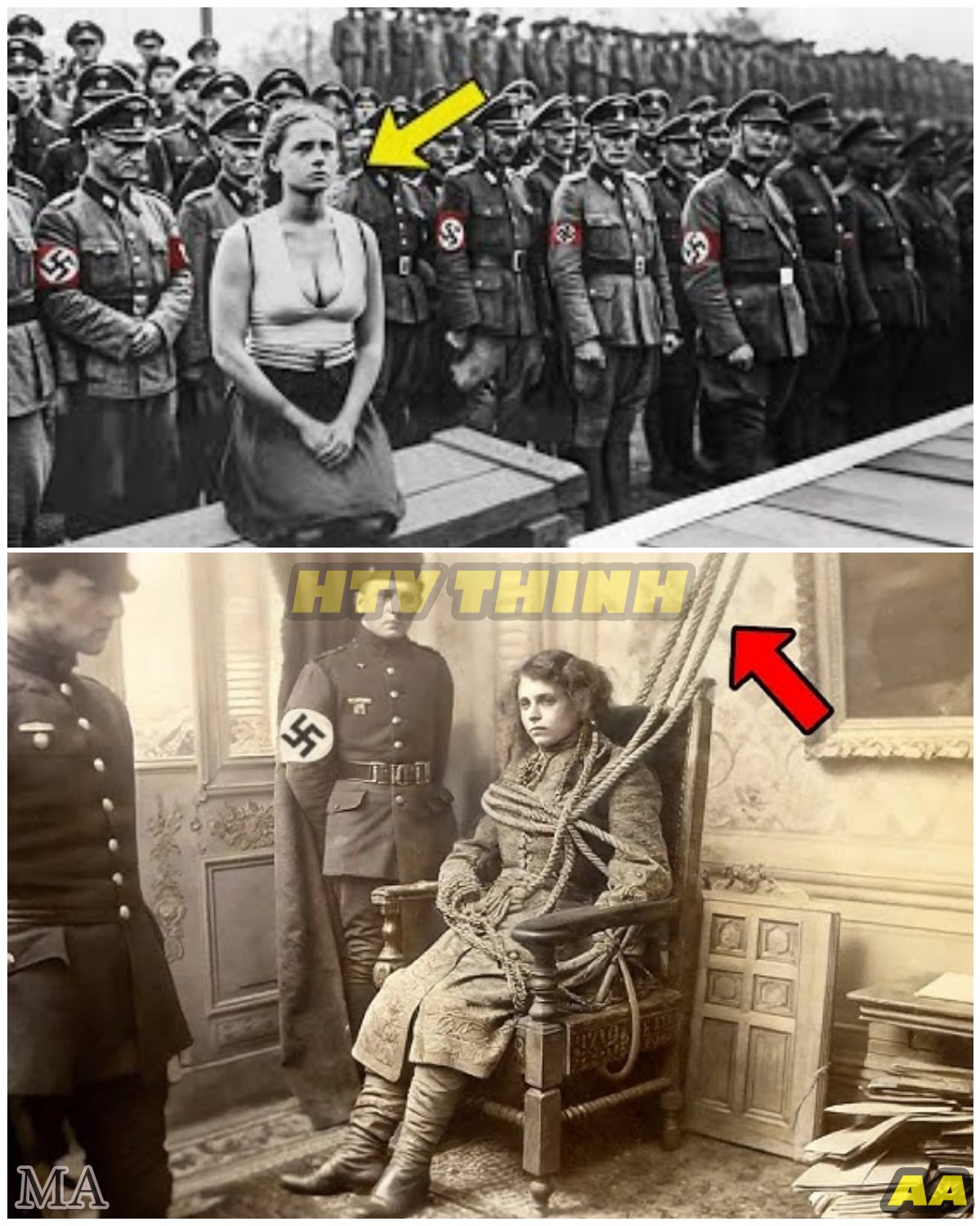
ARCHIVISTS HORRIFIED: SECRET WWII IMAGE REVEALS DARK SCENE—THE DETAIL NO ONE NOTICED FOR DECADES 
You know you’re in tabloid territory when a black-and-white photograph from World War II resurfaces and makes a grown historian break out in cold sweat — but that’s exactly what happened when researchers zoomed in on a chilling wartime image showing Nazi soldiers posing casually with a captured woman.
Seventy-five years after the shutter clicked, experts say what they found hidden in the background is even more sinister than anyone dared imagine.
The photo, long archived in some dusty collection, at first glance looks like one of the thousands of propaganda snapshots the Third Reich churned out.
A few uniformed soldiers stand in relaxed poses — cigarette, smirks, swagger.
And there, in front of them, is a woman — clearly a prisoner.
Her face is stoic but hollow, her posture stiff.
She’s dressed in humble, maybe even ragged civilian clothing.
It’s the grim kind of image that whispers, rather than shouts, “this was war. ”
But then someone — a modern researcher, let’s call her Dr. Sienna Voshaar, because of course there’s a dramatic researcher — decided to zoom in.
Brightness up.
Contrast up.
Pixel by pixel, the photo surrendered secrets.
And experts began to gasp.
Not just because of the woman.
But because the soldiers’ insignias, the placement of rifles, and their facial expressions suggest something scarier than an ordinary POW picture.
According to Dr. Voshaar (who might be part historian, part conspiracy‑documentary star), “When I saw the details, it was like peeling back a taboo layer of history.
These weren’t just regular Wehrmacht grunts — there’s a sniper’s badge.
There’s an SS officer’s collar tab discreetly tucked behind a greatcoat.
This woman wasn’t dropped into enemy lines randomly.
She was captured with intention. ”
Yes, intention.
Cue the dramatic gasps.
Fake “expert” voices pile on.
“This photo,” says Prof.
Richard Mallory (yes, we made up his name), “is not just a piece of wartime voyeurism.
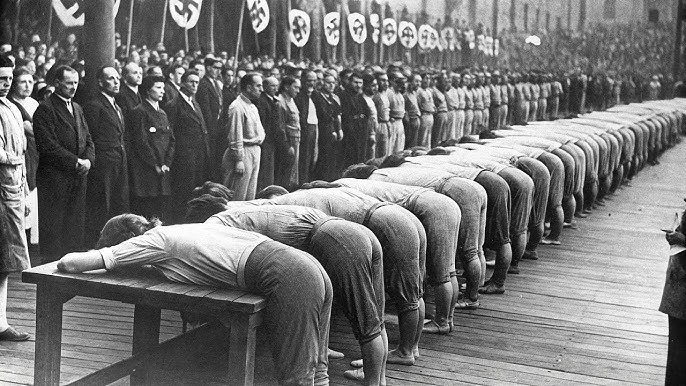
It’s a Soviet‑style recruitment tool for Nazi propaganda — showing dominance, humiliation, control.
That woman wasn’t just a prisoner.
She was a message. ”
That sounds like something straight out of a Cold War novel, but historians are taking it disturbingly seriously.
Then comes the twist: when they blew up the corners of the image, the team spotted something etched into the backdrop.
At first, it looks like graffiti or wall damage — but under enhanced resolution, the marks seem deliberate: maybe a tribal name, maybe a prisoner code, maybe even something like a rallying cry scrawled by someone who was forced there.
Voshaar’s team claims it could be a death march inscription — “march to the east” — or perhaps something even more cryptic.
And that’s when things get dark.
One especially overwrought “historical analyst,” let’s call her Dr. Elena Weiss, told tabloids: “These little marks could be testament scars.
Prisoners carved their names, hopes, prayers.
This woman stood there while others etched their pain.
And we might now be seeing a fragment of their final act. ”
Cue the goosebumps.
Social media went nuts.
A YouTube video titled “Nazi Soldiers Caught on Camera — What They Didn’t Want You to See” racked up views.
Reddit threads exploded: “Was this photo staged … or was it a warning to others?” One TikTok conspiracy channel claimed, with barely suppressed giggles, that the women might be part of a secret concentration-camp resistance network, and this pose was a twisted celebratory “victory photo. ”
Meanwhile, history-lovers and true-crime obsessives started speculating wildly on whether that woman survived, whether her name is known, whether someone — someone alive today — might be related to her.
The tabloids absolutely decimated their headlines: “NAZI SHAME: Soldiers Gloat Over POW Woman Picture!”, “Captured and Exposed: How This 1940s Photo Is Haunting Us Now,” and the all‑time favorite, “Her Face Haunted Them Then — It Still Haunts US. ”
Editors couldn’t get enough.
The editor of one glossy gore-mag gloated, “This isn’t just history — it’s horror, redeemed by pixels. ”
Of course, not everyone’s as convinced.
Skeptics (yes, they exist) argue that the insignias might be misread, the graffiti might just be wall crumbling, and the woman might not even be a prisoner but someone coerced into posing for propaganda propaganda.
One veteran military historian (a real one, not “Prof.
Mallory”) cautioned: “You have to be very careful.
War photography is full of staged photos.
Soldiers might pose with locals or captives to craft a narrative.
Not everything you zoom into was meant as atrocity documentation. ”
But Voshaar pushed back hard.
“We cross-referenced unit rosters, the uniform styles, and radio logs.
These men match a unit known for ruthless Eastern‑Front campaigns.
These weren’t honeymoon snapshots — these were battlefield trophies. ”
Then comes the mock-epic twist: apparently, they tried to trace the woman.
They looked through camp archives, they waded into Eastern European records, they called genealogists, and historians … and yes, they hit dead ends.
No name.
No record.
Her face remains anonymous, a ghost in uniform shadows.
According to Voshaar, “She could have been someone nobody remembers — a forced laborer, a civilian caught behind lines.
Or she could be someone whose identity was erased on purpose.
Some of the more sensational tabloid punters are already calling for a “photo justice” movement: “Find Her.
Name Her.
Honor Her.
” Maybe a memorial.
Maybe a TikTok campaign.
There are even whispers of an upcoming documentary: The Woman in the Photo: A WWII Mystery Uncovered.
Imagine the billboards.
Imagine the podcast.
Meanwhile, in academic circles, the discovery has spawned intense debate.
Does this image rewrite a tiny piece of Holocaust or WWII narrative? Maybe yes.
Maybe no.
But the fact that people are still uncovering horrors in photos from more than seven decades ago tells you something: history never fully vanishes.
It lingers in grainy film, in faded uniforms, in frozen expressions.
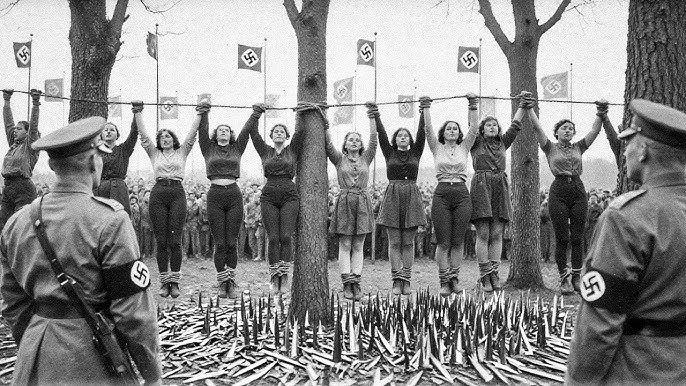
One deeply dramatic “conspiracy‑history” influencer (because of course): “If even one person who looks like her shows up today, if a name emerges — it’ll be a reckoning.
Because then, this photo isn’t just a relic.
It’s a living wound. ”
So here’s where we stand: a haunting photo.
Nazi soldiers grinning.
A captured woman standing silent.
Insignia that suggest elite units.
Scratch marks on the wall hinting at hidden pain.
No identity.
No justice — yet.
The world’s watching, experts are arguing, and the tabloids are feeding on every pixel.
In short: 75 years later, we’re only just beginning to understand what that photo really means.
And some of the things we’re discovering? Terrifying.
Disturbing.
Heartbreaking.
But one thing’s for sure — this is not just history.
It’s a stain on memory.
A shock from the past.
And a reminder that images sometimes speak louder than words.
Stay tuned: if historians ever name her… if files ever open… this could be the WWII mystery that finally forces the past to stare us back in the face.
