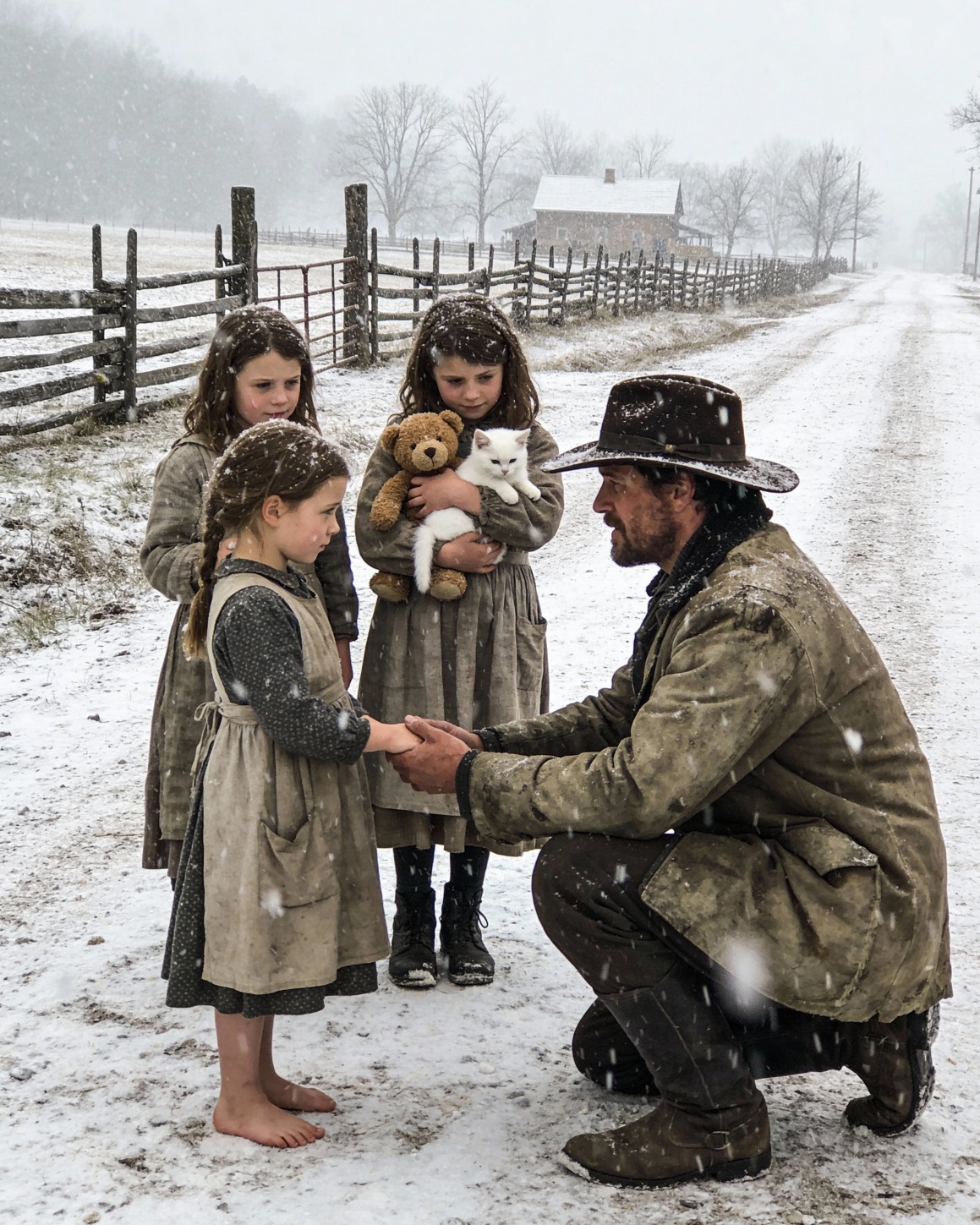
The vow had been whispered so softly that even the wind almost missed it, yet it weighed more than a loaded rifle in Tomás Herrera’s hands. He remembered the exact moment it left his mouth—his breath fogging the air above a grave crusted with ice, the earth too frozen to accept flowers, the priest’s words breaking apart as if they were afraid to land.
Clara lay beneath that ground, and beside her, a child who had never learned the shape of his father’s face. Tomás had stood there long after everyone else left, his boots sinking into the snow, and promised something he did not yet understand: that he would never turn away those who had nowhere to go. At the time, it felt like a sentence spoken into emptiness. Five winters later, it returned to collect its debt.
In Copper Creek, people called him the farmer from the plains ranch. They said it with a mixture of distance and respect, as if naming him too directly might invite something uncomfortable. Tomás was a man of few words, a man who looked you straight in the eye and didn’t blink first.
He treated animals better than he treated gossip, and he preferred the sound of wind scraping the barn walls to the chatter of the town café. What no one said out loud—what no one wanted to remember—was that the silence around him was not natural. It had been carved into place on the same night he lost his wife and son, a night when joy and grief collided so violently that neither survived intact.
Since then, the big house had been filled with only three things: the creak of his boots moving from room to room, the radio murmuring when the quiet grew too sharp, and the wind rattling the wood like a hand trying the door. Tomás let it rattle. He had learned that some things needed to be heard without being answered.
That morning, the snow lay thick and clean, a white skin stretched tight over the land. Tomás stood at the kitchen counter pouring coffee, steam rising like a fragile peace offering. The stove crackled behind him.
He had just lifted the mug to his lips when the knock came—soft, uncertain. He frowned, listening. No one came to the plains ranch unannounced in winter. The second knock followed, weaker than the first, as if whoever stood outside already regretted being there.
When Tomás opened the door, the cold bit his face, sharp and immediate. The porch looked like a fragment of another world, frozen mid-breath. And there, standing in the snow, were three little girls.
They were thinly dressed, coats soaked through, shoes stiff with ice. The eldest stood straight despite the cold, her lips cracked, her eyes steady in a way that only comes when childhood has been cut short.
She held the hand of a smaller girl clutching a rag doll with one eye missing, its fabric darkened by moisture. Between them stood a girl with dark hair, half tied back by a frayed ribbon, her chin lifted in defiance that didn’t quite mask her fear. She looked at Tomás as if she already knew something essential: that compassion is beautiful, but not always safe.
“Our mother died this morning,” the eldest said. Her voice did not tremble, though everything else in her did. “We have nowhere to go.”
The words struck Tomás with physical force. He felt the warmth from the stove dim inside his chest, replaced by a cold that had nothing to do with the air. He didn’t see trespassers. He saw shadows pulling themselves out of a past he had buried with Clara. His throat burned when he tried to swallow.
“So,” he heard himself say, surprised by the steadiness of his voice, “you’re home.”
The sentence landed between them as if it had been waiting years to be spoken.
He stepped aside. The girls hesitated only a heartbeat before crossing the threshold. The warmth of the stove wrapped around them instantly. Their coats dripped onto the floor, leaving dark marks that spread like spilled ink. They smelled faintly of smoke, distant and clinging, as if they had walked through an invisible fire and carried it with them.
Tomás moved on instinct. Blankets from the cedar chest. Old shirts, clean but worn. Wool socks he had knitted years ago and never used. He set them by the stove, motioning gently. He didn’t ask questions yet. Misery, he knew, had its own grammar, and too many words could make it fall apart.
When the soup began to steam on the table, the eldest finally spoke again.
“My name is Alma,” she said, her voice careful. “This is Lía… and the little one is Ruth, but we call her Ru.” She pointed to each in turn. Then she reached into her coat and pulled out a package wrapped in cloth, sewn shut with blue thread. “Mom said to give this to you if anything happened.”
Tomás’s hands froze mid-motion. The thread—he knew that color. Clara used it. The same shade, the same careful stitch she favored when she didn’t want seams to show. A dry shiver ran up his spine.
“What was your mother’s name?” he asked, keeping his voice level.
“Magdalena,” Alma replied.
The name fell onto the table like a full glass no one dared touch.
Magdalena. He had spoken that name once, years ago, by the river, when the moon had promised him a different life. Magdalena had been Clara’s friend—and before Clara, she had been the woman he almost chose. He hadn’t seen her since the day she wished him happiness with tear-bright eyes and walked away carrying her dignity like a shield.
With clumsy fingers, Tomás untied the cloth. Inside lay a folded letter and a silver locket engraved with a flower he recognized from Clara’s old sketchbook. He opened the letter, and it felt as though his heart had been placed directly into his hands.
Tomás. If you are reading this, my voice will no longer be here to explain it. I didn’t have time.
His breath caught.
I trust your word—the one I heard by Clara’s grave, when you promised shelter to those with no one. My daughters have no one. And there is something else… Lía is your daughter.
The word daughter struck him square in the chest. He looked up, his gaze snapping to the girl with the frayed ribbon. Lía sat blowing gently on her soup, focused with solemn care, as if the world could be set right through patience. Her eyes—he could no longer deny it—they were his.
The letter continued, each line tightening the room around him.
Don’t trust Ezekiel Worth. He has papers he intends to use. The locket is the proof; there is a photograph inside. Forgive me for the burden, but your house is the only refuge I could imagine.
Tomás opened the locket with trembling hands. Inside was a small photograph: Magdalena holding a baby with dark curls. On the back, written in familiar ink, were a date and a single initial.
T.
The wind struck the house then, hard enough to rattle the windows, as if something outside had heard its name and wanted in.
Tomás closed the locket slowly. The vow he had whispered by a frozen grave rose up inside him, heavy and undeniable. Whatever had been buried was no longer content to stay that way.
And he understood, with sudden clarity, that the snow on his porch was not the beginning.
It was the threshold.
The wind did not stop rattling the house after Tomás folded the letter. It moved around the walls with intention now, slipping through the smallest cracks, pressing its weight against the windows as if testing how much resistance remained inside him.
He stood there for a long moment, the silver locket cold in his palm, the girls’ quiet breathing and the soft clink of spoons against bowls forming the only human sounds in the room. Five winters of solitude had trained him to endure silence, but this was different. This silence was crowded. It held names, promises, and a truth that refused to stay folded.
Alma noticed first. She always did. She looked up from her soup and watched his face change, watched something settle into place behind his eyes. Children who grow up fast learn to read adults the way others read weather. “Is something wrong?” she asked carefully, already bracing herself for an answer she might not want.
Tomás cleared his throat, the sound rough. “No,” he said, and then corrected himself. “Yes. But not in a way that means you’re leaving.” He paused, choosing his words as if they were tools that could break if used carelessly. “You’ll stay here. All of you. As long as you need.”
Relief passed across Alma’s face so quickly it almost hurt to witness. Ruth clutched her doll tighter, leaning closer to her sister, while Lía simply nodded, as if she had expected nothing else. That quiet certainty unsettled him more than fear would have. Children should not have to be certain about adults. They should be allowed doubt.
After the girls had eaten and fallen asleep on pallets near the stove, Tomás sat alone at the table with the letter spread out before him, reading it again by the low yellow light.
Each line revealed a layer of Magdalena he had never known, a strength sharpened by years of watching dangers approach without the luxury of turning away. She had trusted him with more than shelter. She had trusted him with truth, and truth, he knew, demanded action.
Ezekiel Worth.
The name scraped against memory like rusted metal. Ezekiel had been a fixture on the edges of Copper Creek for as long as Tomás could remember—a man who dealt in paper and persuasion, who smiled with his mouth and measured with his eyes.
He had handled property transfers, wills, loans. He had always been helpful. Always present. Always just close enough to benefit when something changed hands. Tomás had never liked him, but dislike had seemed too thin a reason to worry.
Now it wasn’t thin at all.
At dawn, Tomás saddled the old truck and drove into town, the locket and letter secured in the inside pocket of his coat. He left Alma a note written in block letters, clear and calm: I’ll be back before dark. Lock the door. Don’t answer it for anyone. He did not explain more. Fear, like silence, could do damage if given too much room.
The courthouse records office smelled of dust and disinfectant. Tomás stood at the counter while the clerk retrieved files, his jaw tight, his hands steady only because he forced them to be. Deeds. Trusts. Transfer documents.
The paper trail told its story slowly, but it told it clearly. Magdalena’s property—what little she had—had been encumbered by liens she could not have afforded. Guardianship papers had been filed, then withdrawn.
A provisional claim regarding the girls’ custody sat incomplete, unsigned by a judge, but stamped and ready. Ezekiel Worth’s name appeared everywhere, like a watermark you only see when you hold the page up to the light.
Tomás copied what he could and left with a weight behind his eyes that had nothing to do with age.
By the time he returned to the ranch, the sun was low, throwing long shadows across the snow. He slowed the truck before the turnoff, scanning the road. Tire tracks cut through the fresh powder—new ones. His pulse sharpened. He parked behind the barn and approached the house on foot, every sense alert. The door was closed. The windows intact. Smoke rose steadily from the chimney.
Inside, Alma stood near the table, her shoulders squared. “A man came,” she said before he could ask. “He said his name was Mr. Worth. He wanted to talk. I told him you weren’t home.” She lifted her chin. “He didn’t like that.”
Tomás exhaled slowly, controlling the surge of heat in his chest. “Did he try to come in?”
“No,” Alma said. “But he looked at the windows. Like he was counting.”
That night, Tomás didn’t sleep. He sat at the kitchen table with the rifle across his knees, the radio off, listening to the house breathe. The girls slept in the back room, bundled together, their dreams restless but intact.
He understood now what Magdalena had feared. Paper could move faster than people. Fear could be filed, stamped, enforced. Ezekiel Worth would return, not with anger, but with documents and polite words meant to take children away quietly.
By morning, Tomás had decided.
He drove to the nearest city and spoke to a lawyer whose reputation was built on refusing easy deals. He laid out the letter, the locket, the photograph. He told the truth without decoration. The lawyer listened, then nodded once. “If what you’re saying is true,” she said, “we move first. Before he does.”
The filings went in that afternoon. Emergency custody. Injunctions against asset manipulation. Requests for review of prior submissions tied to Ezekiel Worth. Paper met paper, and for the first time, Tomás felt the ground resist.
Ezekiel came back two days later, this time with a smile sharpened by impatience and a briefcase that looked heavier than it should have been. Tomás met him on the porch, the cold air between them like a drawn line. “You don’t need to come back,” Tomás said evenly. “You don’t have standing here.”
Ezekiel’s smile thinned. “We’ll see,” he replied, tapping the briefcase lightly. “People with paperwork always do.”
Tomás did not step aside. “So do people with truth.”
Ezekiel’s eyes flicked past him, toward the windows, toward the warmth inside. For the first time, uncertainty crept into his expression. He nodded once, as if acknowledging a delay rather than a defeat, and turned away.
As the truck disappeared down the road, Tomás closed the door and rested his forehead against the wood. The vow by the frozen grave pressed against his chest, heavy and alive. He was no longer alone in it.
And neither were the girls.
Winter tightened its grip on Copper Creek as if the land itself had decided to test Tomás’s resolve. Snow fell in deliberate sheets, erasing tracks almost as quickly as they were made, turning distances deceptive and sound unreliable.
The ranch, once a place of chosen solitude, had become a perimeter to defend—quiet, vigilant, awake. Tomás rose before dawn each morning, not because he needed the extra hours, but because sleep now felt like a luxury he could not afford.
He split wood, checked fences, kept the radio low, and listened. Inside, the girls learned the rhythms of the house: where the floor creaked, how the stove breathed, which window caught the sun first. Safety, Tomás understood, was not a single act. It was repetition.
The court moved with the patience of stone. Papers were filed, counterfiled, stamped, and scheduled. Ezekiel Worth appeared everywhere Tomás expected him to be and in places he did not. He attended town meetings he had skipped for years, spoke to neighbors with renewed warmth, and donated to causes that photographed well.
He cultivated the image of a man burdened by responsibility, thwarted by sentiment. Meanwhile, Tomás learned the vocabulary of law—the difference between guardianship and custody, between standing and influence. The lawyer coached him to answer only what was asked, to resist the pull of indignation. “Truth doesn’t need volume,” she reminded him. “It needs sequence.”
Sequence came with Alma’s testimony. She was too young to be a witness by choice and too old to be spared the necessity. In the quiet room outside the courtroom, she sat straight-backed, hands folded, listening as Tomás explained what would happen and what would not.
“You tell what you know,” he said gently. “You don’t guess. You don’t protect adults from their choices.” She nodded once, absorbing the rule the way she absorbed most things—with a seriousness that felt older than her years.
When she took the stand, her voice was steady. She spoke of visits that never happened, of papers presented with smiles, of questions that felt like traps. She did not accuse. She described. The room leaned toward her without realizing it.
Lía watched from the bench, legs swinging, the frayed ribbon retied with care that morning. She did not understand the words, not fully, but she understood tone. When Ezekiel’s lawyer smiled too broadly, she frowned.
When Tomás stood, she sat taller, as if posture could be shared across distance. Ruth slept through most of it, her rag doll tucked beneath her chin, oblivious to the fact that her future was being argued in measured phrases and footnoted exhibits.
The photograph from the locket changed everything. Enlarged and entered into evidence, it refused to be dismissed. Dates aligned. Handwriting experts spoke. The initial—T—became a hinge the case turned on. Ezekiel objected, then adjusted, then tried to recast the narrative as confusion rather than intent. Confusion did not survive the emails.
Confusion did not survive the timeline. When the judge asked Ezekiel to explain why provisional filings had been prepared but never submitted, why guardianship language appeared and vanished like a mirage, his answers thinned. Paper has a way of remembering what people wish it would forget.
Outside the courthouse, snow fell again, quieter this time, as if the storm had tired of its own insistence. Tomás did not celebrate the temporary injunction when it came. He returned to the ranch and chopped wood until his shoulders burned, grounding himself in the present.
That night, Alma asked a question she had been holding back. “If we stay,” she said, not looking at him, “what does that make us?” Tomás considered the fire, the way flames leaned together without touching. “It makes us a household,” he said finally. “Families take longer.”
Ezekiel tried one more time, and this time he came alone. He arrived at dusk, the sky bruised purple, his briefcase conspicuously absent. He spoke of compromise, of arrangements that would spare everyone pain. Tomás listened without interrupting.
When Ezekiel finished, Tomás shook his head once. “You mistake pain for inconvenience,” he said. “You also mistake patience for weakness.” Ezekiel’s eyes hardened, then softened, then hardened again. He left without another word. The road swallowed his taillights.
Spring came late, and when it came, it arrived all at once. The creek broke its ice with a sound like a held breath released. Mud replaced snow. The girls ran without slipping. The court set a final date.
Evidence stacked neatly now, like boards ready for framing. On the morning of the ruling, Tomás dressed with care—not to impress, but to honor the gravity of what was being decided. He did not bring the rifle. He brought the locket.
The judge spoke plainly. Ezekiel Worth’s filings were found to be manipulative, his conduct unethical. Custody was awarded to Tomás Herrera, with full standing and protections. The words fell like measured rain, soaking in.
Alma closed her eyes. Lía gripped the bench until her knuckles went white. Ruth clapped once, then stopped, unsure if applause was allowed. Tomás bowed his head—not in triumph, but in acknowledgment.
They returned home to a house that felt different without changing. The vow by the frozen grave loosened its grip, not because it had been fulfilled, but because it had found its shape. Protection had demanded more than courage.
It had demanded time, restraint, and the willingness to let truth do its work. That evening, Tomás cooked too much food and no one complained. They ate until the plates were clean and the quiet felt earned.
Later, when the girls slept, Tomás placed the locket in a small wooden box beside Clara’s old sketchbook. He understood now that love does not compete with memory. It widens to make room. The house creaked as it always had, but the sound no longer asked to come in and claim something. It settled, like a place that had finally learned its name.
To be continued.