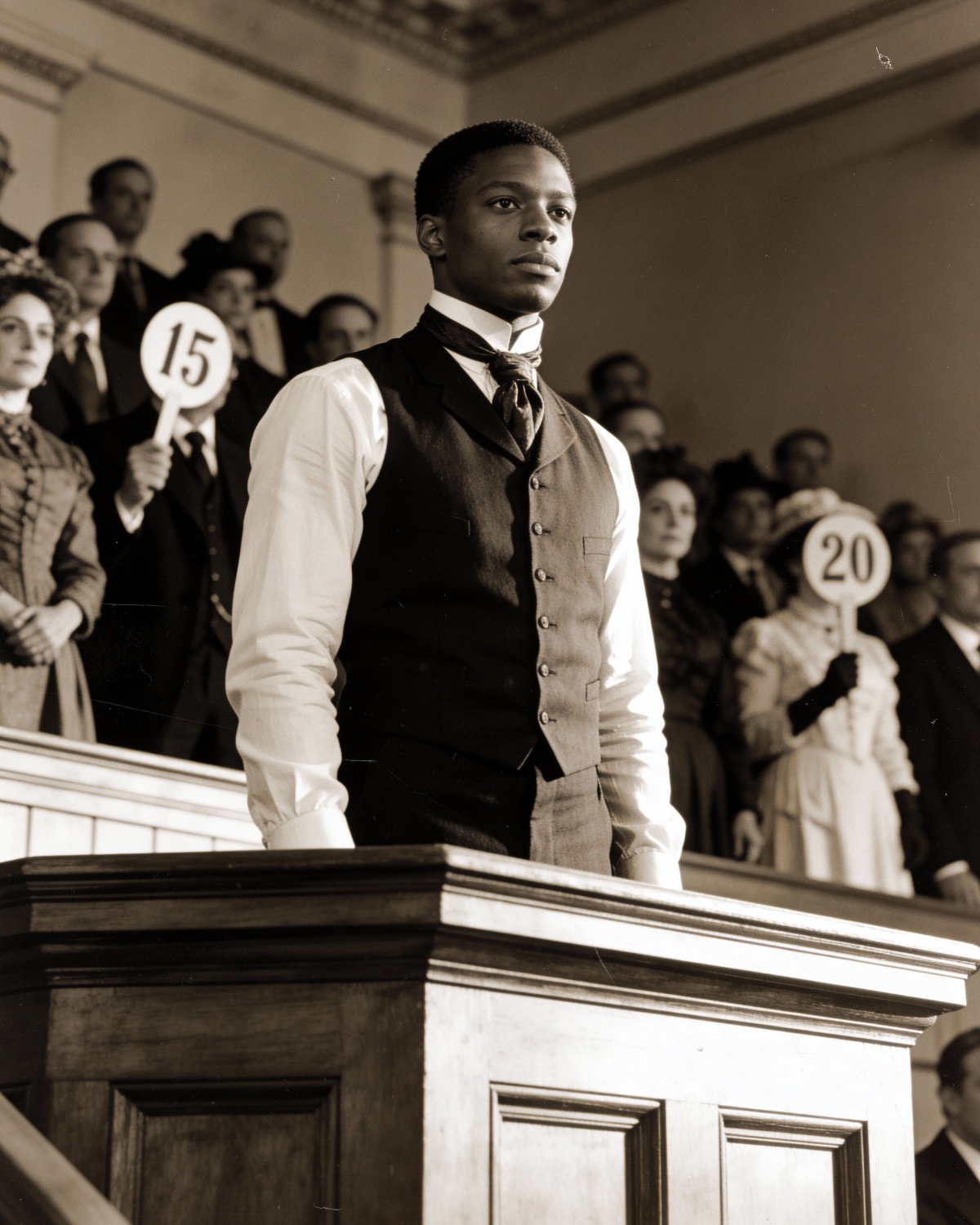
The gavel did not fall. In the humid, stifling air of the Richmond auction block in May 1855, time itself seemed to congeal like cooling tallow. Silas Thorne, the city’s most ruthless auctioneer, stood with his wooden mallet frozen mid-air, his mouth slightly agape. The rowdy crowd of tobacco barons, land speculators, and high-society vultures had fallen into a silence so absolute it felt physical. The only sound was the frantic buzzing of a fly against a grease-stained window and the distant, rhythmic thumping of the James River against the docks.
The cause of this paralysis stood center-stage. He was a young man, perhaps twenty, with skin the color of cream poured over gold and features so finely carved they seemed to mock the rough-hewn timber of the platform.
His hair was a chaotic crown of obsidian curls, and his eyes—strange, luminous, and unsettlingly amber—did not seek the floor in shame. He looked out at the assembly of men who sought to own him with a gaze of such cold, regal indifference that several men in the front row instinctively adjusted their collars, feeling suddenly stripped bare.
He was a “fancy piece,” the ledger noted, but the term felt like a blasphemy. He possessed an “impossible beauty,” a term the Richmond Whig would later use to describe the haunting elegance that turned the auction into a fever dream. For seventeen minutes, not a single bid was uttered. The air grew heavy with a collective, breathless lust—not merely for the flesh, but for the sheer power of possessing something that looked like a fallen god.
“Five thousand,” a voice finally croaked. It was Silas’s own voice, trying to break the spell.
“Ten thousand,” barked Julian Vane, a man whose family had held the Virginia tidewater since the crown grants.
The room erupted. It wasn’t a bidding war; it was a massacre of common sense. The price climbed with a frantic, desperate energy. Men shouted over one another, their faces flushed purple, their fortunes being cast into the fire for the right to claim the golden youth.
“Twenty thousand dollars!”
The shout silenced the room. Julian Vane stood trembling, his eyes bloodshot. It was a staggering, ruinous sum—enough to buy three plantations and a fleet of ships. It was the Vane family legacy, liquefied into a single moment of madness.
The gavel fell. The youth, whose name was whispered to be Elias, did not blink. He merely turned his amber eyes toward Julian Vane and offered a smile so faint, so razor-thin, that it looked less like a gesture of submission and more like a predator acknowledging its dinner.
The Vane plantation, Oakhaven, was a monument to Southern Gothic arrogance. White pillars rose like bleached bones against the dark green of the pines. But the moment Elias crossed the threshold, the atmosphere of the estate shifted.
It was subtle at first—the way the hounds, usually fierce and territorial, whimpered and retreated into the crawlspaces when he passed. The way the mirrors in the grand hallway seemed to hold his reflection a second longer than they should, the silver backing tarnishing in his wake.
Julian Vane was a man possessed. He ignored his wife, a fragile woman named Clara who spent her days weeping in the rose garden, and his business interests began to rot. He spent his hours in the library with Elias, though no one knew what they spoke of.
The house slaves whispered of “The Golden Shadow.” They saw Elias walking the grounds at night, not as a captive, but as a surveyor. Where he stepped, the grass seemed to yellow. The ancient oaks, for which the estate was named, began to drop their leaves in the height of summer, the foliage turning a bruised, sickly black.
“There is something in him, Julian,” Clara hissed one night, her voice trembling with terror. “He is not a man. He is a mirror. Have you seen your face lately? You are wasting away while he grows more radiant.”
Julian ignored her. He was obsessed with the youth’s stories—tales of ancient cities, of debts that spanned generations, and of a “Great Leveler” that was coming for Richmond. Elias spoke with a vocabulary no slave should possess, in a voice that sounded like silk sliding over a whetstone.
Within three weeks, the Vane fortune was gone. Bank notes were called in; crops failed in the field as a mysterious blight turned the tobacco to ash overnight. Julian Vane, once the king of the James River, was a shell of a man, haunted by the beauty he had purchased with his soul.
The “Reckoning” began in the third week of June. It started with the men who had been present at the auction. A strange, languid fever took hold of Richmond’s elite. It wasn’t the yellow jack or the cholera; it was a sickness of the mind and the blood. Victims reported seeing a beautiful youth standing at the foot of their beds, his amber eyes glowing in the dark. They would wake up with their strength drained, their memories fractured, and their secrets spilling from their lips like bile.
In the clubs and counting houses, scandals erupted. Ledger books revealed embezzlements that had been hidden for decades. Affairs were exposed in the bright light of day. The social fabric of Richmond began to tear as the city’s leaders turned on one another, driven by a paranoiac madness.
At Oakhaven, the end came with a terrifying quiet.
Julian Vane was found in his library, staring into a dead fireplace. He was catatonic, his skin pulled tight over his bones, his hair turned white. Elias was gone. The heavy iron shackles Julian had kept in the corner were melted, twisted like wax.
Clara Vane walked onto the porch and saw a figure standing at the edge of the woods. It was Elias. He was no longer dressed in the rags of the auction block, but in a suit of such exquisite tailoring it seemed woven from the night sky itself. He looked at the crumbling mansion, the dead trees, and the ruin of a dynasty.
“Who are you?” she cried out, her voice breaking the heavy silence.
Elias turned. His beauty was now terrifying, a radiant, predatory heat that made the air shimmer. “I am the interest on a debt your fathers forgot they owed,” he replied. His voice carried across the lawn like a cold wind. “I am the beauty that reveals the ugliness beneath. Richmond built its towers on bone; I have merely come to turn the marrow to dust.”
By the time the sun rose, Elias was gone, and Oakhaven was a smoking ruin. No fire had been set, yet the wood had turned to charcoal, the marble to powder. The “Reckoning” swept through the city for another month, leaving the powerful in the gutter and the cruel in the asylum.
The mysterious stranger was never seen again in the flesh, though for decades after, whenever a family grew too arrogant, whenever a fortune was built on too much blood, the people of Richmond would look toward the shadows. They remembered the seventeen-minute silence. They remembered the $20,000 ghost.
They realized, too late, that some things are too beautiful to be owned, and some debts can only be paid in the currency of ruin. The young man of impossible beauty hadn’t been a slave; he had been a mirror, and when Richmond looked into him, it finally saw its own rotting heart.
The ruins of Oakhaven did not stay silent for long. While the Vane family collapsed into the annals of tragedy, the city of Richmond began to realize that the “Golden Shadow” had not acted alone. The fever that gripped the elite was not merely biological; it was informational.
In the wake of Elias’s disappearance, a series of thick, vellum envelopes began appearing on the doorsteps of the city’s most prestigious counting houses. Each was sealed with an unfamiliar crest: a snake consuming its own tail, stamped in gold wax. Inside were not threats, but truths. Detailed records of ships that had “mysteriously” sunk for insurance money, the names of children abandoned in the slums by their aristocratic fathers, and the true origins of the fortunes that built the grandest mansions on Franklin Street.
The “Reckoning” was no longer a ghost story; it was a scorched-earth campaign.
Silas Thorne, the auctioneer who had first felt the paralyzing spell of Elias’s beauty, was the next to fall. He was found in his office, surrounded by his ledgers. He wasn’t dead, but he was babbling, his eyes fixed on the empty space where the auction block had been. He kept repeating a single phrase: *”He didn’t have a shadow. The sun was behind him, and the floor stayed bright.”*
When the authorities checked Silas’s personal safe, they found it empty of gold. In its place was a single, perfect white lily that refused to wilt, and a note written in a hand so elegant it looked like copperplate engraving: **”The price of a soul is never paid in coin.”**
Despite the spreading rot, the Richmond elite attempted to maintain the facade of normalcy. Governor Sterling, a man whose family wealth was tied to the very timber used to build Oakhaven, announced a midsummer ball. It was meant to be a show of strength, a middle finger to the “superstition” and “hysteria” gripping the city.
The ballroom was a sea of silk and lace. Gaslights hissed, casting a flickering, sickly yellow glow over the dancers. But the air was cold—unnaturally so. Guests shivered despite their heavy layers.
At midnight, the music died. Not a gradual fade, but a sudden, violent snap of violin strings.
The heavy oak doors of the ballroom swung open. There was no herald, no announcement. Only a presence.
Elias walked in.
He was no longer the captive youth. He wore a coat of midnight velvet and a waistcoat embroidered with golden thorns. His beauty was now so sharpened it felt like a physical weight on the lungs of everyone in the room. Beside him walked a figure hidden in a heavy grey cloak—the “Highlander” of this era, a silent enforcer whose very aura suggested a lifetime of professional violence.
The Governor stepped forward, his face a mask of sweating bravado. “You have some nerve showing your face here, boy. You’re a runaway. A thief. I’ll have you hanging from the docks by sunrise.”
Elias smiled. It was the smile of a cat watching a mouse run into a corner.
“I am neither a runaway nor a thief, Sterling,” Elias said. His voice was low, yet it carried to the furthest corners of the hall. “I am a collection agent. And tonight, the Governor’s mansion is the bank.”
He reached into his coat and pulled out a small, blackened iron key. He tossed it onto the polished floor. It landed with a sound far too heavy for its size—the sound of a tomb closing.
“Oakhaven was only the interest,” Elias whispered. “Now, I’ve come for the principal.”
Panic is a strange creature. It starts with a single gasp and ends with a stampede.
As Elias stood in the center of the ballroom, the gaslights began to fail one by one. But they didn’t just go out; the flame seemed to be sucked into the vents, leaving behind a thick, oily smoke that smelled of ancient earth and ozone.
In the darkness, the “Reckoning” took its final form.
Men felt invisible hands plucking the rings from their fingers. Women felt their pearl necklaces snap, the beads clattering to the floor like hail. But more importantly, the secrets started to pour out. In the pitch black, voices began to speak—not the voices of the guests, but the voices of those they had wronged.
The Governor heard the cry of the laborers trapped in his burning mills. The bankers heard the pleas of the widows they had evicted. The air was thick with the ghosts of a thousand injustices, all summoned by the golden youth who stood in the center of the storm, glowing with a faint, inner light.
“Who are you?” Sterling screamed, collapsing to his knees as the Scottish enforcer stepped into his personal space.
Elias leaned down, his amber eyes swirling like a storm of gold dust.
“My mother was the girl your father sold down the river to hide his shame,” Elias whispered, his voice for Sterling’s ears alone. “And my father was a power you cannot name. I am the beautiful nightmare you bought and paid for in 1855. I am the end of your line.”
When the sun rose over Richmond the following morning, the Governor’s mansion was standing, but its inhabitants were changed. Sterling was found sitting on the curb, his mind shattered, handing out his remaining coins to the street sweeps and begging for forgiveness.
The auction block where Elias had stood was found reduced to a pile of fine, white ash.
The most terrifying discovery, however, was in the city’s main bank vault. Every bar of gold, every stack of currency, and every deed of property had been replaced with something else: dried leaves from the dead oaks of Oakhaven.
Richmond’s elite were penniless. The “Impossible Beauty” had stripped them of the only thing they valued more than their lives.
The last sighting of the stranger was at the docks. A young man of incredible grace was seen boarding a ship headed for Europe. He was accompanied by a massive man in a grey cloak. As the ship pulled away from the pier, the young man looked back at the city one last time.
He took the graduation photo he had been carrying—the one he had “borrowed” from a future he shouldn’t have known—and dropped it into the dark waters of the James River.
The Reckoning was complete. The cycle of blood and gold had been broken by a man who was both a victim of the past and a predator of the future.
As the ship vanished into the morning mist, the people of Richmond finally understood: Beauty isn’t always a gift. Sometimes, it is a scalpel, used to cut away the rot of a dying world.
Richmond was never the same. In the days following the Governor’s disastrous ball, a haunting silence settled over streets that had once pulsed with the rhythm of carriage wheels and commerce. The proudest dynasties, names that had functioned as the law of the land for centuries, now retreated behind locked doors, trembling at every knock of a postman or the sound of an unfamiliar footfall on the pavement.
The name “Elias” became a curse—a ghost that no one dared to summon. But the most terrifying aspect was not what he had taken away, but what he had left behind: the Truth.
All the suppressed documents, the blood-soaked ledgers, and the evidence of the elite’s most heinous crimes had been scattered to the wind. Commoners, freedmen, and the oppressed began to rise. The power of coin had been shattered by the weight of a beauty that did not belong to this world.
At the ruins of the Oakhaven estate, weeds began to grow with unnatural speed, cloaking the scorched bricks in a matter of days. Locals whispered that on nights of the full moon, the silhouette of a young man could still be seen standing beneath the dead oak tree, staring toward the horizon with a sorrow as old as time.
Aboard the Vesta, as it cut through the waves toward the Old World, Elias stood at the prow. He allowed the salt spray and the ocean gale to toss his obsidian hair. The terrifying radiance on his face had softened, replaced by a weary serenity—the look of a man who had just fulfilled a heavy, ancient sentence.
The massive man in the grey cloak—the silent enforcer—approached, standing behind him like a loyal sentinel.
“The task is complete, my Lord,” the man said, his voice deep and gravelly, like stones grinding at the bottom of a canyon. “Richmond has collapsed from within. Those who deserved to pay have tasted the very hell they spent lifetimes creating.”
Elias lightly turned a gold ring on his finger, the solitary memento he had kept from the ruins of the Vane family. “Pay? It is never enough, Gabriel. I did not destroy them. I simply showed them who they were. The beauty they lusted for was merely the snare that forced them to strip away their own masks.”
He looked down at the ink-black water. “They thought they purchased me for twenty thousand dollars. They had no idea that the true price was the very survival of their bloodline.”
“Where to next?” Gabriel asked.
Elias smiled—a smile no longer predatory, but carrying the mystery of an entity standing outside the flow of time. “Wherever injustice is draped in splendor. Wherever the powerful believe they can use gold to wash away the stains of blood. The world is vast, Gabriel, and the old debts are many.”
In 1856, one year after the legendary auction, a small expedition returned to the grounds of Oakhaven. They found no hidden gold, nor did they find the remains of Julian Vane.
The only thing remaining amidst the charcoal and dust was thousands of white lilies, blooming with impossible brilliance in the dead of winter. They grew from the very spot where Elias had stood when he was put up for sale.
In Richmond, the legend took root: whenever a greedy man seeks to profit from the suffering of others, he will see a young man with amber eyes standing on a street corner, smiling and waiting.
Elias was not a man, nor was he truly a demon. He was the personification of justice delayed—the lethal beauty of the truth when it refuses to remain buried in the dark. That twenty-thousand-dollar contract was never a slave trade; it was a death warrant for an empire built on cruelty.
As the Vesta vanished completely into the Atlantic mist, the story of the “Youth of Impossible Beauty” became a myth. It served as a final reminder: in this world, there are things that can never be bought, and there are souls that will return to reclaim everything they lost, at a price that no treasure on earth could ever hope to pay.
The journey of Elias had only just begun. Other cities, other dynasties, and other secrets awaited him in the shadows of history. And somewhere in the future, his presence would once again command the world to hold its breath for seventeen fateful minutes.